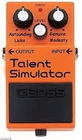
Pepe wrote:A cool forum member at sequencer.de, a German synthesizer forum has shared brand new information about modding a Behringer CC300, the BOSS CE-2 clone, so that it has more headroom, thus leading to less distorted peaks. This is from Tony Allgood at Analog Heaven:
I instantly asked the sequencer.de forum member about the DC-2, because as some of you might know I have always complained about the DC-2's distortion. And that's what he asked Tony Allgood as well:Probably quite a few of you have a little Behringer CC300 pedal. It's their version of the Boss DC-2 Dimension C compact pedal. But there's a problem, the Behringer is very prone to distortion if you don't get the levels quite right.
The problem is caused by two things as far as I can see. Firstly, like the DC-2, the CC300 uses pre-emphasis and de-emphasis EQ to attempt to remove high frequency noise from the BBD circuitry. This boosts treble frequencies on the way in to the BBD and reduces it by an equivalent amount of the way out. However, this only works well if the majority of the audio signal that you want processed lies underneath the minimum frequency of pre-emphasis. Which may be fine if you have a guitar and play open chords, but not so good with a keyboard which can produce extremely bright sounds very high up.
So what happens if we remove all the pre-emphasis and de-emphasis circuitry. Well, the pedal does get a little noisier at the top end - you'll hear a bit more hiss but not that much more since the compander will remove much of the BBD's noise. But you'll also get a lot more headroom for the type of signals that keyboards typically generate - so the horrible nasty distortion will now become less likely.
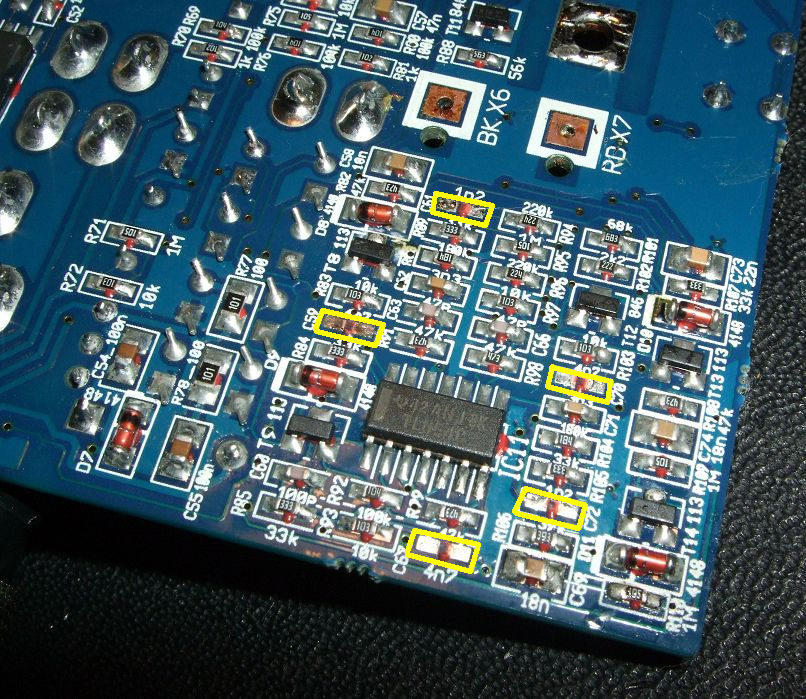
So open the pedal up and remove the following components from the underside of the circuit board:
4n7 capacitors in locations: C67, C59 & C70
1n2 capacitors in locations: C61 & C72
Bear in mind that the CC300 is predominantly surface mount and these capacitors are very small. You can use a standard soldering iron and solder wick if you are careful.
A photograph of the section of the board with the removed capacitors can be found here:
http://www.oakleysound.com/CC300%20mod.jpg
Right the second thing is totally down to Behringer not quite copying the Boss device. They power the BBD circuitry from 5.6V and not 6.8V like the Boss. This will give a lower headroom for the audio signal through the BBDs which is not so good.
This is because Behringer have used a 78L05 in place of Roland's 78L06. Both designs use a diode in the common of the regulator which bumps up the output by around 0.6V. The 78L06 actually produces 6.2V so the Boss device will run their BBDs at approximately 6.8V.
So simply swap out IC8, the 78L05, and replace with a 78L06. IC8 can be found nestled next to the input socket. It's a standard through hole part. The 78L06 isn't particularly common but can be had from the larger suppliers.
Alternatively, you may be able to get a 78L007 from Toshiba and you can replace IC8 with this. If you do so you will need to remove the diode, D7, and replace with a small wire link.
You may wish to trim the two trimmers, VR1 and VR2. These set the BBD input bias voltage, for the left and right BBDs separately, and are set for maximum headroom. I found that even with the change in BBD supply voltage I didn't need to change them. Both should be set so that minimum distortion can be heard with an input signal of around 3V (peak to peak) triangle wave at approximately 220Hz.
Tony
http://takla-makan.bandcamp.com
http://www.oakleysound.com
I think I'm going to try that out soon. I hope that I can finally give the DC-2 the love that it deserves. It rests in a drawer most of the time. Maybe that will change then.> Which caps are this on the DC-2?
4n7: C5, C51 & C52
1n2: C56 & C57
I just tried this modification today. I cannot recommend it at all. It's awful and I reversed it again. The DC-2 did indeed have more headroom and less distortion with hotter signals, but every tiny bit of sound was now accompanied by clearly audible high noise.
So I have to live with the slight distortion here and there, especially with my neck pickup. One day I will try it against the DC-2W and check if the new model has less distortion.